• About
  • Books
  • Films

Postwar Germany

~ 1945-1949

Postwar Germany

Author Archives: Anika

New books page

31 Friday Jan 2014

Posted by Anika in Books

≈ Comments Off on New books page

Tags

books, reading, research, sources

image_cover_mediumAs promised, I finally started a Books page dedicated to deeper reading into the postwar era. The list has nonfiction and fiction books in English and German. It doesn’t scratch the surface of the hundreds of books written in and about postwar Germany, but maybe readers will find a gem or two they didn’t know about.

And if you know a gem or two I haven’t included, please let me know and I’ll add it.

Enjoy!

Postwar — a historian’s achievement

29 Wednesday Jan 2014

Posted by Anika in Books

≈ 4 Comments

Tags

germany, historian, judt, postwar, war

postwar croppedI haven’t finished the late British historian Tony Judt’s major work Postwar: A History of Europe Since 1945, but I wanted to write a brief review anyway. I can’t have a postwar Germany blog without including something about this amazing book.

Amazing not because I agree with everything Judt says. He admits up front much of what he writes is controversial and up for discussion. I like discussion, especially about history. People think history is a done deal, something in the past that doesn’t need to be rehashed. I think history is living memory, even if people who lived it have passed away. And something alive should be argued about, examined, rethought.

For that alone, Postwar is an amazing achievement.

The next thing is the book’s scope. After the Cold War world order fell with the break up of the Soviet Union, Judt thought about taking a new look at the post-World War II era. What everyone assumed was a more or less permanent or even natural state of things — the bipolar world of Soviet Union v. United States — and the role Europe played in it, was really an interlude, Judt argues. The conflicts that arose in Europe after the Soviet Union dissolved are some of the conflicts that lay dormant since World War II (or even World War I). It was time to look at Europe’s history again as a whole, not cut into west and east. Without Cold War blinders or the usual ideological tug-of-war that historians had during that era, it’s now possible to look at the whole postwar era in a new light.

And that’s what Judt did. A sweeping, epic look at sixty years of history framed by two Europes — the one that bled itself in two horrific wars, and the one capable of cooperation in a whole new political form, the European Union.

The book is beautifully written, accessible, full of interesting facts, references and quotes. The controversy comes in what conclusions Judt draws from his material (and what material he chose to include, of course), and when you read the book, you should do it carefully. Germany is so central to the postwar story. It’s what I know most about, so I look most closely at those references in Judt’s book. I got snagged in a problem with one of Judt’s conclusions early in the book, and it bothered me enough that I ended up discussing it with my German husband one night.

It wasn’t even a post-World War II issue, but post-World War I. Judt concluded Germany was in a relatively stronger position than it was before World War I because the cost of the war to the Allies was so high, and Germany didn’t pay its reparations after the war. This struck me as totally wrong, especially if you look at *why* Germany didn’t pay its reparations. This argument can’t ignore the famine, inflation, unemployment, assassinations and civil war fighting in Germany after World War I, as well as its difficult time establishing what for Germany was a brand new and unpopular political structure — a republic. France, which had suffered the worst along with Belgium in the war, sent troops to occupy cities in the German demilitarized zone when Germany couldn’t comply with reparations demands. In 1921 this turned into a full-blown occupation of the Ruhr area, Germany’s center for coal, steel and heavy industry. A “relatively stronger” Germany wouldn’t have allowed this. I’m not arguing about the right or wrong of the Ruhr occupation or even of reparations. I just can’t understand how Judt could conclude Germany was relatively stronger in this situation than it was before the war, even if the losses of the European allies are taken into account.

Regardless, I’m really enjoying Postwar, and would recommend it to anyone interested in 20th century history.


Two kinds of Woman

21 Tuesday Jan 2014

Posted by Anika in Women

≈ 2 Comments

Tags

germany, postwar, trummerfrau, veronika, women

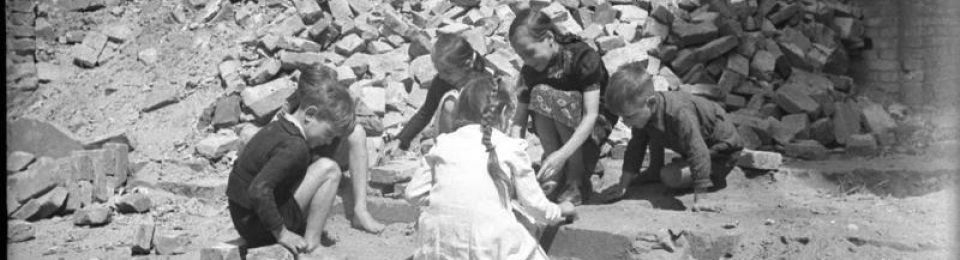
Postwar Germany has two iconic views of women — the Trummerfrau and what the GIs called Veronika Dankeschön. Of course not every woman could be squeezed into one category or other, but they reflect two extreme ways women made do in the postwar world.

Bundesarchiv

Bundesarchiv

I’ll start with the “heroic” icon, the Trummerfrau. It literally means “rubble woman,” and that’s exactly what they were, the women who hammered bricks, shifted the ruins off the streets, salvaged materials for reconstruction. In Berlin alone, about 60,000 women did this work for the extra rations they were entitled to. A woman whose main job was mother and hausfrau received a lot less to eat than the women who cleared the streets. Food rations were everything, especially when the women supported old people and children in the home.

They had to. Their men were missing, killed, severely wounded or emotionally scarred. Suicides after the war were likely to be men. For those few immediate postwar years, the women held society together and laid the groundwork for the country Germany would become, an unusual freedom that would evaporate in the 1950s.

The opposite of the trouser-wearing, dusty, hard working Trummerfrau was the girl people in the era would call “loose,” to put it mildly. The Veronika Dankeschön — the initials purposely spell VD, a serious problem in the postwar world —  used her sex to get the basic things she needed and wanted. Nylons were the stereotype, but women went out with Allied soldiers for many other reasons — food and cigarettes, new music in the Allied clubs, even the hope of marrying and being taken to another country. There was a shortage of German men and a surplus of Allied men, so none of this was a surprise.

Not every woman who went out with an Allied soldier was a Veronika. Plenty of young German women just wanted to have some fun after the war, meet new people, open up to the world. Many did eventually marry. But the Germans as a whole looked warily at the girl who dated an Allied soldier. She might be called an Ami-liebchen (American-lover), a term just short of prostitute.

Once (western) German society stabilized in the 1950s, the Trummerfrau and the Veronika made way for the new ideal of German women. It looked a lot like the old one — respectable wife and mother, a support for her man. What women did in the immediate postwar years to keep their families fed, have fun or seek advantages was swept under the rug. An embarrassment for some, a cause for shame. The postwar years were considered immoral, a time most Germans wanted to forget almost as much as they wanted to forget the war.

*Photo 1: Bundesarchiv, Bild 183-25093-0003 / CC-BY-SA [CC BY-SA 3.0 de (http://creativecommons.org/licenses/by-sa/3.0/de/deed.en)%5D, via Wikimedia Commons

Book: a diplomat’s daughter in postwar Germany

27 Sunday Oct 2013

Posted by Anika in Books

≈ Comments Off on Book: a diplomat’s daughter in postwar Germany

Tags

bruce, essen, hügel, mary, postwar, villa

Quite a few Americans who lived in postwar Germany as children have contacted me since I started this blog. I have some of their stories waiting in the pipeline, but I wanted to introduce the topic with a memoir that has just appeared in German, and will hopefully show up in English soon.

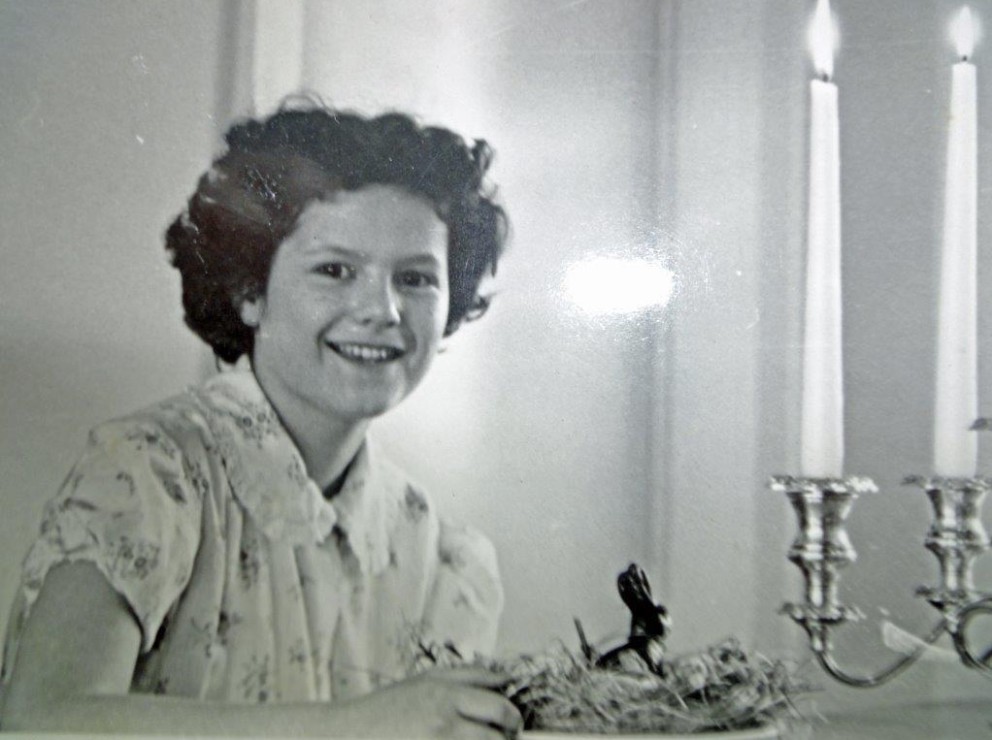
cover Mary Bruce bookSchwimmen in Villa Hügel (Swimming in Villa Hügel) is the story of Mary Bruce, an American 9-year-old who followed her diplomat father to Essen in 1949. Via her father, she had access to the city’s grandest mansion, the Villa Hügel, home of the city’s grandest family, the Krupps. They made Essen the “City of Steel,” and more ominously, the “Armory of the Reich.”

Allied bombings left Essen in ruins, the landscape Mary found when she arrived. She moved between two worlds: the privileged luxury of the Krupp mansion, symbol of the Allied dominance in postwar Germany. And the squalor of the city with its rubble and shortages. Between her father’s work and her mother’s social engagements, Mary was left largely alone to explore a city populated by people she’d been taught were monsters. When she met the German girl Irmgard, she began to accept that this strange place could also be home. Mary Bruce as child

Mary is now a retired literature professor from Illinois. She was kind enough to answer a few question about her book and what writing about her childhood meant to her.

Q: Who did you write the book for?

A: I can’t remember if I, or someone else, suggested I write this book. Basically, the interest Germans showed in my story inspired me, so I wrote it for them – but really, as with most writers, I wrote it for myself.

Q: How emotional was it to write?

A: The experience was both emotional and intriguing, intriguing because once I began reflecting, memories tumbled out. It was like uncorking a bottle of wine and pouring. Yes, I felt many emotions from happy to sad to surprise. The surprise element was just how much I remembered, and also, as I wrote, some pieces of my life fell into place.

Q: Have you heard from Irmgard?

A: I have not found my dear friend Irmgard. This is very sad for me. People have been looking for her, but she has not shown up. I don’t remember her last name, or even her address, as I was at her house only twice. I only hope she is all right.


Pocket Guide to Germany

25 Wednesday Sep 2013

Posted by Anika in Allies, postwar

≈ Comments Off on Pocket Guide to Germany

Tags

american, germany, guide, occupation, troops

Checkpoint Charlie in Berlin is a tourist trap. I hate to say that. It’s a true piece of postwar history. But every time I’ve gone there, it feels more and more like a Disney film. I think it’s cute to get your picture taken with young men dressed as American soldiers in front of a hut with sandbags (not authentic), and the stands lining the street selling faux Russian fur hats and Soviet medals are just funny. But it’s too easy to forget how dangerous the place used to be.

Oh, and there are gift shops. Lots of them. There are so many “authentic” pieces of the Berlin Wall for sale, I get the impression the wall could’ve wrapped itself several times around the whole city.

pocket guideBut I love gift shops, and it was one on Checkpoint Charlie were I found a reproduction of the the Pocket Guide to Germany, prepared by the US Army Information Branch in 1944. It’s a short and handy guide for US troops preparing to occupy Germany. It’s also a great look at the attitude and goals the troops had when the war ended.

There was a real concern that US boys would feel sorry for the Germans, especially the women and children, after they moved in and saw the conditions they lived under. The Pocket Guide tried to keep troops on guard against the dangers of the postwar Germans.

However friendly and repentant, however sick of the laws of the Nazi party, the Germans have sinned against the laws of humanity and cannot come back into the civilized fold by merely sticking out their hands and saying — “I’m sorry.

Troops were told to especially be on their guard against German youth, the generation aged 14 to 28, who spent half their lives or more under Hitler.

Under a section called “Alibis,” the Guide arms US troops with answers to comments Germans might make to downplay their role in Hitler’s regime. Here’s an example.

German line: “After World War I, it was the cruel, inhuman terms of the Treaty of Versailles that made World War II inevitable.”

American answer: “…the Allies’ treatment of Germany after World War I was generous compared with Germany’s treatment of all the countries she has conquered and occupied since 1939.”

Absolutely true.

The Pocket Guide described the land and climate of Germany, some history, a bit of language. But the core goal of this interesting booklet was on page 33.

Let your attitude in Germany be:

Firm–

Fair–

Aloof–

and above all,

Aware…

← Older posts
Newer posts →
Follow Postwar Germany on WordPress.com

Categories

  • 1945
  • Allies
    • British
    • French
    • Soviets
  • Americans
  • berlin
  • Books
  • Children
  • Crime
  • Culture
  • Denazification
  • Everyday life
  • general
  • Hunger
  • Jewish life
  • Media
  • Personalities
  • Politics and government
  • postwar
  • Travel
  • Uncategorized
  • Women

Blog at WordPress.com.

Privacy & Cookies: This site uses cookies. By continuing to use this website, you agree to their use.
To find out more, including how to control cookies, see here: Cookie Policy
  • Subscribe Subscribed
    • Postwar Germany
    • Join 90 other subscribers
    • Already have a WordPress.com account? Log in now.
    • Postwar Germany
    • Subscribe Subscribed
    • Sign up
    • Log in
    • Report this content
    • View site in Reader
    • Manage subscriptions
    • Collapse this bar
 

Loading Comments...