• About
  • Books
  • Films

Postwar Germany

~ 1945-1949

Postwar Germany

Author Archives: Anika

Period footage

10 Monday Dec 2012

Posted by Anika in Media

≈ Comments Off on Period footage

Tags

clips, footage, Ruhr, video

The great part about modern history is you can see it in video. Black and white, scratchy, but it’s enough to make an era feel real.

Recently I stumbled upon Critical Past, a big collection of video snippets online. It says it’s “one of the largest online collections of historic, royalty-free film footage and still images in the world.” I can’t vouch for that, but I’ll give them the benefit of the doubt. The videos I saw – culled from U.S. government sources —  were glimpses into postwar Germany I haven’t seen in too many other places.

There are 6,400 clips from 1945 alone, not all of them in Germany, of course, but many having to do with World War II. Here’s an example from 1946, aerial footage of the industrial Ruhr area where I live now. If photos of the ruins are powerful, video is even moreso. still image ruhr destruction critical past1

Don’t mind the prices on the website. Browsing online is free.


The Bridge

13 Tuesday Nov 2012

Posted by Anika in Culture

≈ Comments Off on The Bridge

Tags

brücke, bridge, british, culture, english, library

Not many institutions from the Occupation of Germany still exist, but I visited one of the last ones recently.

It’s still called Die Brücke, the Bridge. This one in Düsseldorf. The building includes the International English Library and the Volkshochschule (a bit like a community college).

Sixty years ago, the British opened ten institutes for literature and the arts in cities across their Zone. They wanted to build a cultural bridge between the victors and the defeated. The Germans, so starved for world culture under the Nazis, had access to international periodicals, music and dance performances, literature and lectures.

I never guessed how important this issue was until I read postwar German newspapers. Cultural events were listed, many more than I thought there could be in bombed-out cities. In one collection of postwar memories, a returning soldier wrote about attending a lecture about the Italian Renaissance. It was standing room only in the lecture hall, and the listeners came from all walks of German life.

The International English Library in Düsseldorf’s website quotes Günther Grass’ famous novel Tin Drum  to show how important these institutions were to the Germans.

…in those years I educated myself almost free of cost together with thousands wanting to catch up and to educate themselves, took courses in the Volkshochschule, and became a regular in the British Centre, called ‘Die Brücke’.

Most of these centers closed down after Germany recovered its ability to provide its own cultural institutions. The few that survive depend on volunteers, membership and donors.

For me, the International English Library was a cozy place on the fourth floor of the building (the elevator, though, looked like it hadn’t been serviced since the postwar years). The library isn’t big or flashy, but for a native English speaker starved for a place to browse in her own language, it was perfect. The staff spoke in German or English, sometimes switching from one sentence to the next. The accents were British, American and German. The international conversation added to the unique feel of the library. Language, as well as books, builds bridges.

The “Sadness of War”

06 Tuesday Nov 2012

Posted by Anika in Culture

≈ Comments Off on The “Sadness of War”

Tags

army, defeat, military, war

The American presidential election is today, meaning I’ve been swamping myself with US news. An op-ed piece in the New York Times yesterday interrupted my Ami-centered mindset and reminded me of a big issue in postwar Germany.

In “The Permanent Militarization of America,” Aaron B. O’Connell, a history professor at the US Naval Academy, reminds us what former President (and WW2 General) Eisenhower had to say about the military in America, 1961. As O’Connell put it,

He cautioned that war and warmaking took up too large a proportion of national life, with grave ramifications for our spiritual health.

O’Connell argues, effectively, in my opinion, that today’s United States hasn’t heeded Eisenhower’s warning. What does this have to do with postwar Germany?

One of the pillars of the Allied policy on Germany was demilitarization. Disarming the Germans wasn’t the most important point. The blind respect and admiration for war and all things military had to be rooted out of the minds of the Germans. The Allies recognized that Nazism or Hitler weren’t solely responsible for Germany starting World War II. The roots stretched far back, perhaps as far as 1870 when Germany defeated France.  Bismark at last united the fractured German lands into one nation.

German pride became connected not only with culture, but with military might. The industrial strength of Germany was intertwined with its arms industry, showcased at the 1893 Chicago World’s Fair, where the Krupp Gun Exhibit invited visitors to admire some of the world’s most advanced weapons.

Culturally, a Prussian (as people often called it) militarization infested the country. Children often wore miniature uniforms and were raised with the values of obedience and respect for authority. As Heinrich Mann pointed out in his books, especially Der Untertan, society identified itself almost slavishly with its leader, the Kaisers at the time, who of course presented themselves to the nation as military leaders in uniform. Military parades and shows of might were wildly popular.

World War I should have rooted this pro-military attitude out of the Germans. For many, especially on the political left, it did. But soon after the defeat, the right wing, including the National Socialists, propagated the Dolchstosslegende, that let the military and Kaiser off the hook for the devastating war. Other elements on the home front, especially the Jews, they argued, “stabbed the army in the back.” This was just what many Germans, smarting from defeat, wanted to hear. It was fertile ground for the Nazis.

The total defeat of World War II, and the Allied effort to teach democratic values, finally uprooted the Germans’ pro-military attitude. If it wasn’t for the Soviet threat in the postwar world, Germany might have never had another army. By 1955, the Allies saw the need for a buffer army in Europe, and the Bundeswehr, the democratic successor of the Nazi-era Wehrmacht, was born.

Only 10 years after the war ended.

In 1945, Germany was defeated, millions dead, the nation in ruins, a political, social and moral vacuum. The “lingering sadness of war,” as Eisenhower would put it years later, was daily reality. If any people saw the failure of glorifying all things military, it was the Germans of that generation. And it yielded a society that is still today deeply suspect of anything to do with war. In the 1950s, Germans protested against the founding of the new Bundeswehr. Young men refused to follow the draft, thinking they – like their fathers and grandfathers – were to be trained up for another war.

Back to Aaron O’Connell’s essay. This paragraph, read with Germany in mind, is frightening. Let it be a warning.

Uncritical support of all things martial is quickly becoming the new normal for our youth. Hardly any of my students at the Naval Academy remember a time when their nation wasn’t at war. Almost all think it ordinary to hear of drone strikes in Yemen or Taliban attacks in Afghanistan. The recent revelation of counterterrorism bases in Africa elicits no surprise in them, nor do the military ceremonies that are now regular features at sporting events. That which is left unexamined eventually becomes invisible, and as a result, few Americans today are giving sufficient consideration to the full range of violent activities the government undertakes in their names.
Shopping on the black market

09 Tuesday Oct 2012

Posted by Anika in Crime

≈ 2 Comments

Tags

black market, cigarettes, marks, racketeer, schieber

Prices on the postwar black market weren’t just a product of supply and demand. Demand for almost everything was high, supply low. There were price fluctuations for some products, especially fresh food or grain. Otherwise, prices staid surprisingly constant, even between different cities and their different black markets.

Professional black marketeers – called Schieber — grew powerful enough to set stable prices for many goods. These big racketeers ran organizations of small-time black marketeers who did the footwork. During the hunger protests in 1946 and 1947, Germans harangued against the Schieber for setting prices too high. “Hang the Schieber!” they wrote on their signs. The Schieber grew fat and wealthy on the backs of the common people.

Yet the black market was the only truly functioning economy. No one had a choice but to pay the market prices. I’ve gathered many examples from my research, which show just how horribly expensive the black market was.

First, keep in mind the average worker might earn about 150 marks a month in postwar Germany.

1 pound of meat = 3 bottles of wine OR 15 cigarettes OR 80 marks

1 pound of coffee = 500 marks

1 pound of butter = 250 marks

1 pound of bacon = 200 marks

1 pound sugar = 90 marks

1 pound flour = 30 marks

A 3 pound loaf of bread = 25 marks

A man’s suit = 1,000 marks

A ladies’ dress = 800 marks

1 bottle of schnapps = 200 marks

1 pair of nylons = 200 marks

Black Market

02 Tuesday Oct 2012

Posted by Anika in Crime

≈ Comments Off on Black Market

Tags

black market, cigarettes, ration, Reichsmark

Towards the end of World War II, the Nazi state had more and more trouble providing basic food and goods to the German population. To supplement the state-imposed ration, or to horde goods for after the war, some Germans traded on the black market. A risky business — punishment was harsh and could include death.

These limited black markets blossomed after the war into a national phenomenon. Everybody traded on the market, the only way for many people to survive, especially in the cities. The regular food ration set by the Allies was called the “Death Ration” by the Germans. It was too little to live on, and hit mainly old people, those who didn’t or couldn’t work, and — ironically — mothers (as if they didn’t need more calories caring for a household!). The black market supplied what the ration didn’t.

How did it work?

Germany functioned largely on barter. Let’s say a mother in Hamburg had 3 pairs of silk stockings to trade. She wants to supplement the fat ration for her family because fat equals calories that stick to your ribs. She finds a public square or certain street where it’s known people congregate to trade, one of the many black markets in the city. Since such trades are illegal in postwar Germany, people don’t usually shout what they need or write it on a sign. The mother could subtly show her stockings in her purse to the people around her. Or she might wander around, whispering what she wants over and over until someone agrees to a trade. Her silk stockings would buy her one bottle of cooking oil or a pound of butter.

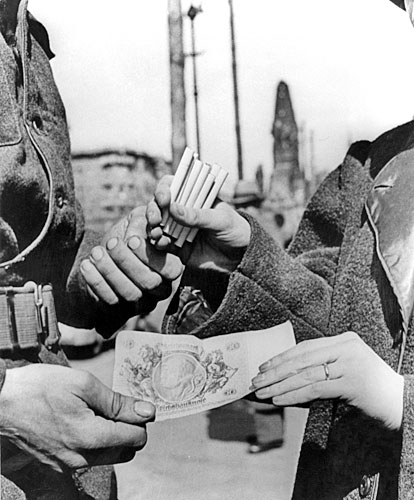
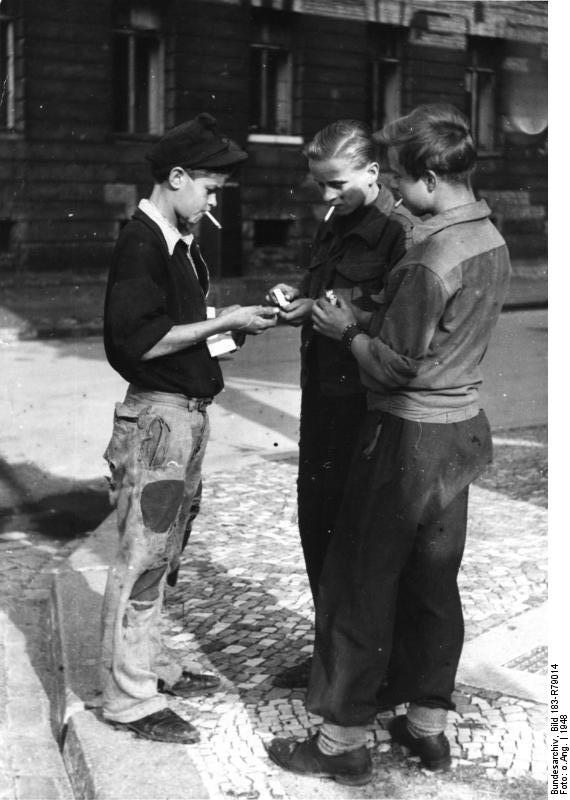
The Reichsmark was all but useless after Nazi Germany’s collapse. The new currency was the cigarette, preferably American ones (called “Amis”). In certain times and places, one Ami cigarette cost between 6 and 20 Reichsmarks. In Frankfurt, the Americans set up a barter center where Germans could trade products legally. American soldiers and racketeers took advantage of the situation, and if they worked together, they could both make a killing. The racketeer has a starting capital of 1 Leica camera. He trades it with a soldier for 5,000 cigarettes. The soldier exports it to the States, and someone sells it for him for $600. That money, back in Germany, can buy 134,000 cigarettes or 27 Leicas.

Most people on the postwar black market weren’t in it to get rich. They were trying to survive in a world where everything — food, clothing, shoes, light bulbs, needle and thread, coal and most other things — were scarce.

← Older posts
Newer posts →
Follow Postwar Germany on WordPress.com

Categories

  • 1945
  • Allies
    • British
    • French
    • Soviets
  • Americans
  • berlin
  • Books
  • Children
  • Crime
  • Culture
  • Denazification
  • Everyday life
  • general
  • Hunger
  • Jewish life
  • Media
  • Personalities
  • Politics and government
  • postwar
  • Travel
  • Uncategorized
  • Women

Blog at WordPress.com.

Privacy & Cookies: This site uses cookies. By continuing to use this website, you agree to their use.
To find out more, including how to control cookies, see here: Cookie Policy
  • Subscribe Subscribed
    • Postwar Germany
    • Join 90 other subscribers
    • Already have a WordPress.com account? Log in now.
    • Postwar Germany
    • Subscribe Subscribed
    • Sign up
    • Log in
    • Report this content
    • View site in Reader
    • Manage subscriptions
    • Collapse this bar
 

Loading Comments...