• About
  • Books
  • Films

Postwar Germany

~ 1945-1949

Postwar Germany

Author Archives: Anika

The End

08 Friday May 2015

Posted by Anika in 1945

≈ Comments Off on The End

Tags

allied, end, germans, victory, war world

VE_Day_celebrations_on_Bay_Street_1945It’s been 70 years since the official end of WW2 in Europe. A good time to be grateful. Western Europe hasn’t seen a significant conflict on its soil in three generations. No matter what people think of terrorism, it isn’t a World War.

The Cold War wasn’t (or isn’t) fun. The threat of nuclear annihilation that influenced the second half of the 20th century was real. But those were fears, those were threats. That wasn’t a firestorm raining from the sky, or tanks rolling through towns, or child soldiers, or gas chambers. There are wars all over the world right now, but nothing like that.

Here in Germany, there’s been a lot of information about the end of the war in the media. It’s taken all those years for survivors to speak up, mostly children back then, now in their 70s and 80s. They still don’t wholly understand what they lived through. “It’s incomprehensible,” they say. It may be hard to imagine what it was  like, but we – the younger generations – need to try every once in a while. Not in the knee-jerk, finger-pointing sort of way. Those of us who live comfortably and in peace need to remember how fragile that is, and how privileged we are.

In many places, my home country for one, we’ve passed into a pseudo-peace where wars are fought in our name all over the world without us knowing what’s really going on. That’s a scary situation, and one that could lead to very bad places, as I noted in a post a couple of years ago about the Sadness of War.

But still, nothing going on today has the scale of WW2. I get the sense the Germans are immensely grateful for the peace they’ve lived since then. On a political level, they’re still aware of Germany’s responsibility to the past. That’s why the German chancellor Angela Merkel will attend ceremonies in Moscow (the former western allies won’t go, because of the Ukraine conflict). As skeptical as I am about Russian politics today, I think it’s right to honor what the Soviet Union did in WW2. It took the brunt of the fighting, and the deaths, defending their land from invasion.

In western Germany, the Americans were the real winners of WW2. 1945 started a love affair with all things American that didn’t truly break until the Iraq War. The US was the “Schutzmacht,” Germany’s protector. In the past 15 years or so, the public skepticism about the US and its interests has grown. The recent scandal about the German intelligence service spying on European interests for the Americans is fuel for the fire. The Germans are grateful for everything the US had done for them after WW2, but there are calls to move on. The ex-Schutzmacht can’t be trusted like it used to.

That leaves Germany, a central member of the European Union, trying to find its role 70 years after the catastrophe it brought upon the world. For years, international polls have shown how admired modern Germany is, and people around here tend to be slightly stunned when they learn this. They’re more used to the childish and vicious reminders of Germany’s past, like in Greece when people put a Hitler mustache on a picture of Merkel, or show her with a swastika. As if any other country in the world has dealt better with its dark past than Germany.

Photo: VE Day Celebrations on Bay Street, Canada. By John H. Boyd [Public domain], via Wikimedia Commons. http://commons.wikimedia.org/wiki/File%3AVE_Day_celebrations_on_Bay_Street_1945.jpg
Liberated or Conquered

21 Tuesday Apr 2015

Posted by Anika in Uncategorized

≈ 2 Comments

April is an important month for much of Germany when it comes to World War II. The general surrender was signed in May 1945, but April was the month when city after city surrendered directly to allied forces. That makes now — April — the 70th anniversary of. . . .

What exactly?

Recently my local newspaper in Essen featured an article about this time period called As the Americans freed the Ruhr Region. That was an interesting take on what happened. It made me as an American, think — Did the US free this part of Germany? Or did it conquer it?

At the time, the Allies made it clear they were here to conquer, not to liberate. But they were slick. They dropped leaflets to the populace urging them to turn against the Nazi officials and surrender their cities without fighting. Many did. Maybe this was the moment when the war weary Germans began to conjure up the idea of being liberated from the Nazis, no matter what their political persuasion was in the past.

That attitude carried through right up to the present. It seems a lot more fashionable to talk about the liberation of the Germans than it is to talk about the conquering of Germany. There’s no denial that it happened; American, British, French and Soviet forces occupied German territory and held military bases far too long for the Germans to close their eyes to what happened.

But now, 70 years later, with most of Germany back in German hands and the old allied forces all but gone, we’re left with the idea that the Allies freed the Germans from a criminal regime.

That’s only somewhat true. At bottom, the Allies came to win the war. And so I’d re-title that recent article, As the Americans Conquered the Ruhr Region.

The German Myth Nobody Wants Debunked

23 Monday Feb 2015

Posted by Anika in Books, postwar, Women

≈ 8 Comments

Tags

germany, myth, postwar, Treber, trummerfrau, women

There’s a fascinating argument going on in Germany right now. It digs at one of modern Germany’s founding myths.

In one corner is the historian Leonie Treber of the University of Duisburg-Essen, so my neck of the woods. Her dissertation just appeared as a book called The Myth of the Rubble Women (Mythos Trümmerfrauen).

In the other corner is, well, most people who actually lived in the immediate postwar years and care to comment in the media about Treber’s book.

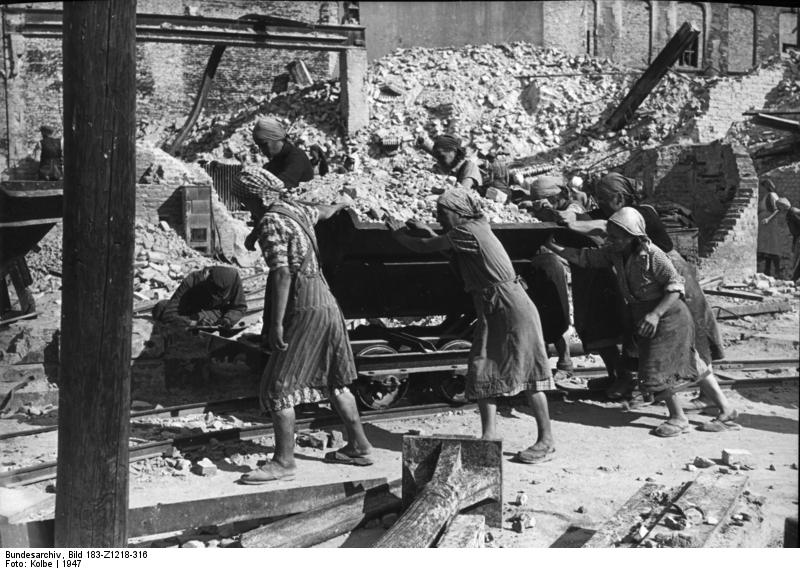
As I wrote in a post last year on postwar Germany’s iconic women, the Trümmerfrau Trümmerfrauen bei der Arbeitis the heroine of the country’s rise from the ruins. Treber argues this is a legend that evolved in the Sixties and Seventies in West Germany (earlier in East Germany).

She analyzed government documents related to reconstruction in 11 German cities and concluded the women generally didn’t stack bricks or push rubble on carts. Most of the work was done by removal and construction companies. In the immediate postwar years, she says, there was no term “Trümmerfrau,” and only in Berlin and cities in the Soviet Zone did women do significant amounts of work in the ruins.

When I first heard about this, I thought, “Uh-oh.” Treber is tarnishing one of the beloved images of post-Nazi Germany.

Modern West Germany needed to reinvent its history, create its own founding myths. Every country does it. The “rise from the ashes” story needed its heroes at a time when there were very few to go around. Postwar Germany in the late Forties and into the Fifties was in many areas still clearly in the hands of ex-Nazis. The men wouldn’t be the image of the new Germany. The women who got on with it while the men were imprisoned, broken or dead — they kept society together.

And that’s where myth and memory clash with data. My local paper the NRZ published excerpts of some of the mostly infuriated letters-to-the-editor that arrived after the paper reported on Treber’s book.”The suffering of these women isn’t even appreciated,” one said. Another didn’t hold back: “What is this silly goose thinking when she defames the proven achievements of the Trümmerfrauen?”

Some letters insisted they used the term Trümmerfrau as early as the Fifties here in western Germany. They pointed out that not only did their mothers carry bricks, so did the children (and some men, of course). It wasn’t a matter of rebuilding whole city blocks, it was about the family home, the shop, the school. People rebuilt their own neighborhoods brick by brick. The private stories have poured in, and if you know German, you can read some on the WAZ (NRZ) newspaper group site here.

Treber’s book has gotten some attention for its controversy, and it’s fun to watch. My opinion? A good story is sometimes “truer” than the facts. It isn’t important to measure the achievements of these women in cubic meters of rubble. Postwar German women were the first to pick up the pieces — because they had to. For that, they deserve a place in Germany’s founding story.

Photo:Bundesarchiv, Bild 183-Z1218-316 / Kolbe / CC-BY-SA [CC BY-SA 3.0 de (http://creativecommons.org/licenses/by-sa/3.0/de/deed.en)%5D, via Wikimedia Commons http://upload.wikimedia.org/wikipedia/commons/b/b1/Bundesarchiv_Bild_183-Z1218-316%2C_Tr%C3%BCmmerfrauen_bei_der_Arbeit.jpg

Propaganda films

06 Friday Feb 2015

Posted by Anika in Media, Uncategorized

≈ 4 Comments

Tags

american, british, film, germany, postwar, propaganda

We’d like to think propaganda is the brainwashing a non-democratic country does to its people, or false information it tries to shove on the world. We don’t do that kind of thing.

But propaganda is just media that delivers a political message. Everybody does it. After World War 2, the Americans and British used films to inform the public about the conditions in defeated Germany. They show fascinating period footage. The commentary may be even more interesting.

Check out an episode of “This is America” on Germany 1947. US soldiers teach Germans baseball and English, they play golf to pass the time. “Occupation Girls” live in mansions with German servants. But be warned, the commentator says: The Germans are waiting for a new Führer. They nurse old hates. Two years after the war, the United States urges its people back home to stay vigilant.

And here’s a film from the British Pathé Pictorial Looks at Berlin 1947. There’s a subtle glee in the descriptions of German destruction that probably went down well in post-Blitz England. The commentator can’t resist an ominous warning here too: Will a new war-monger rise from the rubble?

Both films take jabs at the Soviets in Germany. The American film is more obvious about it. The Allies are laying the groundwork in their films for a new, Cold War enemy, while reminding viewers that the old Reich may still be a threat.

Haunted by the past

19 Monday Jan 2015

Posted by Anika in Uncategorized

≈ Comments Off on Haunted by the past

I usually don’t write about modern Germany, but there’s been a development lately I can’t ignore.

In Dresden, people have been gathering for Monday demonstrations, marches that protest immigration from Islamic countries. They apparently fear for the future of European civilization. They call themselves PEGIDA — Patriotic Europeans against the Islamic influence in Europe. Its organizers claim no links with Neo-Nazis and violent football hooligans, though there’s enough crossover to raise more than one eyebrow.

The Pegida movement has spread to other cities in Germany (using similar acronyms), and for the most part run peacefully. The protesters refuse to speak to the media. They are told not to shout any slogans that might be reported falsely in what they call the “Lügenpresse” — the lying press, a word the Nazi propaganda minister Goebbels loved to use in his day. Regular people attend the protests, and men with black scarves over their faces. Nobody could quite figure out what Pegida people want because they never talked to anyone.

A silent protest.

A disillusioned middle class marching with the far right wing is not new in Germany. It happened in the 1930s and it brought down the Weimar Republik.

The German government, local and federal, know that. There are calls to take Pegida’s fears seriously, and of course they enjoy the right of free speech. But on the whole, the official response is counter-protest. Even going so far as to turn off the lights of national landmarks and whole cityscapes.

This might be unique. At least I’ve never heard of it before. For a march in Cologne, the head of the city’s landmark, the Dom, shut off all the lights of the magnificent cathedral. The old city and the bridges over the Rhine also remained dark. The protesters shouldn’t have a photogenic backdrop. In Berlin, the Brandenburger Tor was darkened.

At the same time, tens of thousands of people have gathered in cities across Germany to support tolerance, freedom and the rights of all people. When 18,000 gathered in Dresden alone, several times that gathered around the country.

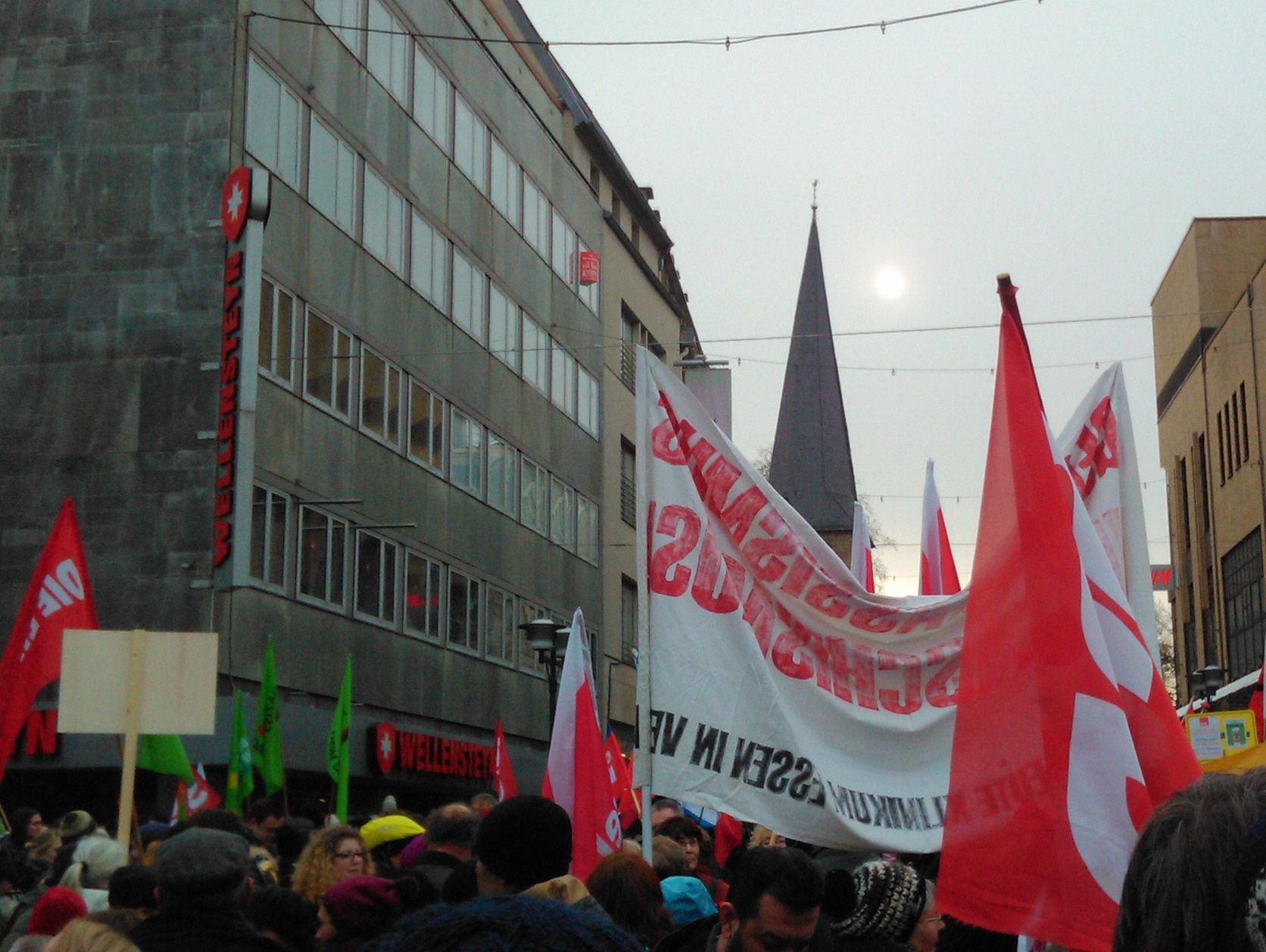
protest cropped2Yesterday, 5,000 people marched through the pedestrian zone of Essen, the city I live in. It was a march for human rights. I was there, because I know history. The current German government is far stronger than Weimar ever was. The spirit of Nazism won’t take over democratic rights as easily as Hitler did in 1933. But when I heard what some Pegida people said, I had a shiver of recognition. So did Jewish groups in Germany, who warn against Pegida. As one Jewish leader said, scapegoating starts with one group of people, and where does it end?

Pegida and anti-Pegida demos in Dresden have been banned for now because of assassination threats on Pegida organizers. Now the public discourse has shifted to whether the ban cuts Pegida’s right to free speech. Pegida leaders even held a press conference. Or as the national weekly Der Spiegel put it, a “Lying-press conference.”

Back to the real issues. I believe people should talk seriously about the threat radical Muslims and others are to world peace. We should talk about immigration. We should freely critique government policy. But the discussion should be done openly, with level heads. It shouldn’t be hijacked by fear — from the political right or left, or from terrorists. It’s a turbulent moment in Germany, and a test of its democracy. And its people. I have confidence in both.

← Older posts
Newer posts →
Follow Postwar Germany on WordPress.com

Categories

  • 1945
  • Allies
    • British
    • French
    • Soviets
  • Americans
  • berlin
  • Books
  • Children
  • Crime
  • Culture
  • Denazification
  • Everyday life
  • general
  • Hunger
  • Jewish life
  • Media
  • Personalities
  • Politics and government
  • postwar
  • Travel
  • Uncategorized
  • Women

Create a free website or blog at WordPress.com.

Privacy & Cookies: This site uses cookies. By continuing to use this website, you agree to their use.
To find out more, including how to control cookies, see here: Cookie Policy
  • Subscribe Subscribed
    • Postwar Germany
    • Join 90 other subscribers
    • Already have a WordPress.com account? Log in now.
    • Postwar Germany
    • Subscribe Subscribed
    • Sign up
    • Log in
    • Report this content
    • View site in Reader
    • Manage subscriptions
    • Collapse this bar
 

Loading Comments...