• About
  • Books
  • Films

Postwar Germany

~ 1945-1949

Postwar Germany

Tag Archives: germany

Postwar photos for everyone

03 Tuesday May 2016

Posted by Anika in Media

≈ Comments Off on Postwar photos for everyone

Tags

Bundesarchiv, germany, photos, postwar

A few years back, the Bundesarchiv (German Federal Archive) announced it was donating tens of thousands of photos to Wikimedia Deutschland. The result has been a treasure trove for anybody interested in German history. I’m grateful for the donation, and here are just a few of the great postwar images we all get to see because of the Bundesarchiv’s generosity.

No new shoes, Berlin, 1946. Bundesarchiv, Bild 183-M1129-321 / Donath, Otto / CC-BY-SA 3.0
Train travel, Bahnhof Spandau-West, Berlin, 1947. Bundesarchiv, Bild 183-N0304-308 / Donath, Otto / CC-BY-SA 3.0
CARE package, 1948. Bundesarchiv, Bild 183-S1207-502 / CC-BY-SA
Destruction in the Neues Museum, Berlin, 1949. Bundesarchiv, Bild 183-S89884 / CC-BY-SA 3.0
Babylon cinema, Berlin, 1948. Bundesarchiv, Bild 183-1984-0517-511 / Heilig, Walter / CC-BY-SA 3.0
Daily ration for 1 person in the British Zone, Germany, 1948. Bundesarchiv, Bild 183-H28811 / CC-BY-SA 3.0
Bathing by the Bunker am Zoo, Berlin, between 1946 and '48. Bundesarchiv, Bild 146-1982-028-14 / Hoffmann, Otto / CC-BY-SA 3.0
Bathing by the Bunker am Zoo, Berlin, between 1946 and ’48. Bundesarchiv, Bild 146-1982-028-14 / Hoffmann, Otto / CC-BY-SA 3.0
Caught stealing coal, Berlin, 1946. Bundesarchiv, Bild 183-N0207-366 / Donath, Otto / CC-BY-SA 3.0

Slave labor and living history

09 Wednesday Mar 2016

Posted by Anika in Crime, general, Soviets

≈ 2 Comments

Tags

germany, history, nazi, postwar, Russians, slaves, students

Here in Germany, my kids aren’t old enough to learn about the Nazi era in school yet. So I recently jumped at the chance to see what high school-age students were doing. It’s hard enough getting young people interested in all that old stuff. And anything short of virtual reality probably wouldn’t impress them, right?

So off I went to what the press was calling a “lecture performance” of 12th graders from the Burggymnasium in Essen. The venue piqued my interest too; the performance took place in the wartime air raid bunker under the city archive.

Bundesarchiv, Bild 183-B25447 / CC-BY-SA 3.0

Soviets deported to Germany, June 1942. Bundesarchiv, Bild 183-B25447 / CC-BY-SA 3.0

But first we crowded into the archive’s foyer in front of a table where two students in blouses and braided hair sat working. Cheerful period music was echoing in the hall, and it made me feel a little uneasy. We were there to learn about forced labor in wartime Germany – hardly cheerful. In clipped tones, the students called for us to get in line. It was dawning on some of us that the performance had already started.

When we entered the building, we were handed a card with a number and had been told it would be used to divide up the groups since the bunker space was so small. But once we got to the table in the foyer, we gave up the first number and were given another — mine was 721 — written on white tape. “Wear it in a visible place,” they told us. I slapped mine on my coat without asking what the number was for. I had a pretty good idea.

Numbered, I had to walk alone between two students in white shirts and dark pants. They stood at the foot of the stairway leading down to the basement. They held file folders, and as each of us walked by, they said in a bland tone, “Follow the directions.” Always this firm, impersonal tone. I was impressed and a little uneasy the students managed it so well.

In the narrow basement hallway, more students in white ordered us to go right or left. I joined the group waiting quietly in the right-hand hall. Maybe the others felt the same way I did, caught off balance by how quickly we obeyed what seemed like random orders.
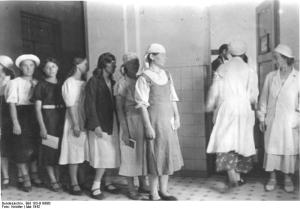
Ukrainian women examined by German officials for work. May 1942. Bundesarchiv, Bild 183-B19880 / Knödler / CC-BY-SA 3.0

A door opened. This wasn’t the bunker yet, but a medium-sized room where thirty of us crowded inside. The windows were covered for the blackout. There were students in white shirts at a table with a scale, some bread and a cooking pot. There were students in baggy or shabby clothes lined up, their heads bowed. The “man in charge” talked to us then, complained about how hard it was to feed these people — the shabby ones, the Ukrainians dragged to Germany to work. When he had a question for us, he barked, “How much did a slave worker eat per day, number 721?” We looked down at the numbers on our coats, trying to remember who (what?!) we were. He talked about duty, and how if he wasn’t firm, if he failed in his duty, his own family would suffer. At which point he gave one of the student-slaves a mock kick and walked off.

The slaves spoke too — at first about home. How much they missed it, how their home gave them strength to endure. One scrubbed the floor as she talked about her fear of getting sick, of not being able to work anymore. It was uncomfortable having to look down on her the whole time. An air raid and sudden darkness, and we were evacuated out of the room.

To the bunker. Through a narrow door, we climbed into a nest of rooms with bare and dusty walls. Here and there, someone had stenciled the capacity the rooms had — 25 people, for instance, in a space too small to be comfortable. As we wandered from room to room, students acting as slaves told their stories of being snatched from their villages in the Ukraine or Russia. The journey to Germany in freight trains and the yearning for fresh air, space and freedom. Their work — sometimes with German families who treated them kindly; more often in factories, especially in Essen, where they were worked to exhaustion or death. Two students were closed into a replica of the famous steel locker used as an isolation cell and punishment for forced labor. There was poetry and artwork and period photos beamed on the walls. A group of students sang about home in German and Russian to a guitar accompaniment.

When we left the claustrophobic nooks and crannies of the bunker, the performance was over. My first thought was — these 12th graders put together one of the most informative and moving bit of living history I’d ever experienced. They had studied the testimony of forced labor and the Germans in charge of them to understand what went on in their own words. Students who spoke Russian translated some documents fully into German for the first time. But it was the performance itself, creating it, writing it and performing, that brought the students closer to the tens of thousands of slave workers forced to come to Essen more than 70 years ago.

An excellent performance and a great experience. Bravo.
 

War criminals move in

15 Friday Jan 2016

Posted by Anika in Allies, Crime, Personalities, postwar

≈ 2 Comments

Tags

germany, nuremburg, postwar, prison, spandau, war crimes

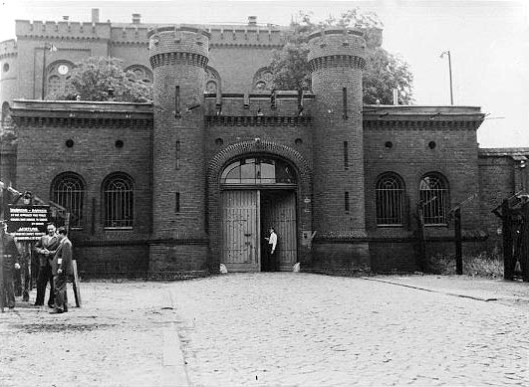
6th_Inf_Regt_Spandau_Prison_1951

Spandau Prison 1951, public domain

I’ve always considered Spandau Prison a bit like something in “news of the weird.”

On July 18, 1947, the seven top German war criminals to survive World War 2 moved into their new prison in the Spandau district in Berlin. Rudolf Heß, odd bird and formerly Hitler’s favorite, had a lifetime sentence. So did the economic minister Walther Funk and the head of the navy, Erich Raeder. The wily Albert Speer got twenty years, not for being Hitler’s architect, but for feeding the Third Reich’s armaments factories with slave labor from occupied lands. Baldur von Schirach got 20 years for his role in the Hitler Youth. Konstantin von Neurath got 15, and Karl Dönitz, Reichspresident after Hitler’s death, got 10.

The Allies weren’t taking any chances. The criminals were locked into individual cells in the former fortress prison with guards from all four victorious powers, who rotated the duty every month.

If there was any sign of how dangerous the Allies considered these men, this was it. An entire prison for 7 people in isolation as if they were a cancer – which they were. Still, it’s amazing how much time, effort, resources and money the Allies poured into that prison for so few men for thirty years.

I’m not sure if the special treatment helped these men maintain a certain status that it would’ve been best to wipe out right away via keeping them in a normal prison. In isolation, but a run-of-the-mill one, same as any other max security prisoner would get. It would’ve been nice to see these war criminals cut down to size.

The prison isn’t there anymore, and here’s why. Rudolf Heß, 93 and the last inmate, killed himself in 1987. With that, the prison had fulfilled its purpose. It was torn down so that neo-Nazis who revered Heß couldn’t use it as a shrine.

1946 and how it changed the world

15 Tuesday Dec 2015

Posted by Anika in Books

≈ Comments Off on 1946 and how it changed the world

Tags

1946, anikascott, germany, postwar, sebestyen

1946I don’t know how I missed this one. Last year the journalist and historian Victor Sebestyen gave us his take on the watershed year 1946 in his nonfiction book 1946: The Making of the Modern World. I just saw the hardcover at my local German bookstore, but I haven’t read it yet. There’s a lot of postwar stuff out there right now, and this one appears to zero in on that first postwar year as the moment the political landscape shifted all over the world, for better (fall of colonial empires) or worse (the Cold War).
If anyone has checked it out already, let me know what you thought!

Anything is possible

24 Tuesday Nov 2015

Posted by Anika in 1945, Americans, postwar

≈ Comments Off on Anything is possible

Tags

anika, cologne, germany, postwar, ruins

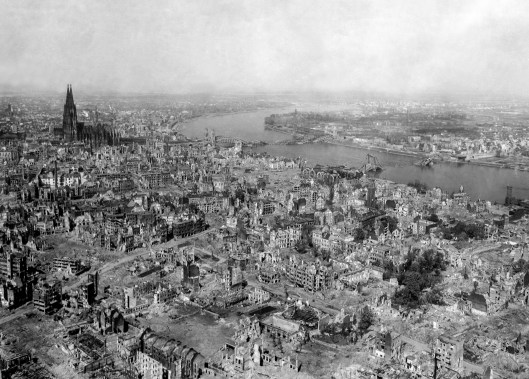
It’s natural to feel dismay at scenes of devastation, but what about hope? Cologne was about 75% destroyed in WW2, yet it’s still here, still wearing silly costumes at Karnival time, and telling really bad jokes to bad music. The amazing Cologne Dom still pierces the clouds. As bad as the world’s conflicts are, there’s always hope — to rebuild, and go on living.

Here was Cologne on April 24, 1945, view taken by the US Department of Defense (now public domain).

Koeln_1945 US Department of State

Here’s Cologne in 2010.

Kölner_Innenstadt_(Flight_over_Cologne) Neuwieser commons 20(Photo: Neuwieser, Wiki Commons 2.0)

← Older posts
Newer posts →
Follow Postwar Germany on WordPress.com

Categories

  • 1945
  • Allies
    • British
    • French
    • Soviets
  • Americans
  • berlin
  • Books
  • Children
  • Crime
  • Culture
  • Denazification
  • Everyday life
  • general
  • Hunger
  • Jewish life
  • Media
  • Personalities
  • Politics and government
  • postwar
  • Travel
  • Uncategorized
  • Women

Create a free website or blog at WordPress.com.

Privacy & Cookies: This site uses cookies. By continuing to use this website, you agree to their use.
To find out more, including how to control cookies, see here: Cookie Policy
  • Subscribe Subscribed
    • Postwar Germany
    • Join 90 other subscribers
    • Already have a WordPress.com account? Log in now.
    • Postwar Germany
    • Subscribe Subscribed
    • Sign up
    • Log in
    • Report this content
    • View site in Reader
    • Manage subscriptions
    • Collapse this bar
 

Loading Comments...