• About
  • Books
  • Films

Postwar Germany

~ 1945-1949

Postwar Germany

Tag Archives: germany

New Places page

31 Monday Mar 2014

Posted by Anika in postwar, Travel

≈ Comments Off on New Places page

Tags

allies, germany, places, postwar

If you ever wondered where to go for some authentic postwar German history, check out the new Places page. I’ve kicked it off with the allied power centers in postwar Berlin with brief descriptions and photos. Over time, I’ll be adding more places from around Germany and museum collections around the world. As always, your suggestions are very welcome!

Instructions for British Servicemen in Germany

25 Tuesday Mar 2014

Posted by Anika in Allies, British

≈ Comments Off on Instructions for British Servicemen in Germany

Tags

bodleian, british, germany, servicemen

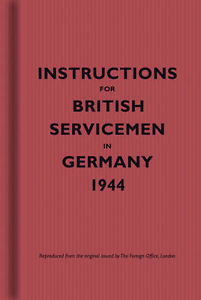
British servicement instructionsI found this little gem during my last trip to London. It’s a reproduction of the handbook published by the Foreign Office in 1944. The war was still on, and as British forces pushed into Germany, the Tommies needed a bit of guidance for how to deal with what was still an enemy people. Instructions for British Servicemen in Germany could be called a pre-occupation manual. It looked forward to the immediate postwar era, and has much in common with the similar American handbook I mentioned on the blog awhile back.

Maybe the biggest similarity is the booklet’s appeal for soldiers to rein in their natural tendency to feel compassion for people who look like (and are) suffering. That these are Germans, collectively held responsible for the war at that time, didn’t matter. The writers from the Political Warfare Executive recognized what might happen to young soldiers sweeping into an environment largely free of German men. Ruined cities and towns where women, old people and children welcomed western troops like liberators. The American and British booklets were clear. Western forces didn’t enter Germany to liberate it, they came to conquer.

That meant establishing a conqueror’s distance from the defeated. Fraternization was forbidden, and shortly before the end of the war, soldiers could be fined for doing it. The reality of life in occupied Germany soon put a stop to the stricter rules. In the forward of the Bodleian Library’s reissued Instructions, John Pinfold mentions a Daily Express cartoon from July 1945 that showed German women chasing British soldiers through a wood. The caption: “Rough on us chaps that don’t want to fraternise, isn’t it?”

The booklet has sections that made me laugh and cringe. A section titled “What the Germans are Like” was so good, I had to read it to my German husband. The list of negative traits and stereotypes was long, but I giggled at the sentence, “The Germans have, of course, many good qualities.” (My husband says the same thing about Americans, and with the same dry tone.) A British person reading the booklet now would probably be interested in the section “What the Germans Think of Us.” Generally positive, due to what the booklet called British “national virtues” like tolerance, fairness and decency.

And that’s the booklet’s true value. It helps us understand one view of how Britons saw Germans and themselves at a turning point in the Twentieth Century.

8 million Nazis

24 Monday Feb 2014

Posted by Anika in Denazification

≈ Comments Off on 8 million Nazis

Tags

berlin, document, germany, munich, nazi, party

After the war, when Germany went into denial (which lasted quite a few years, if Bundesarchiv_Bild_183-M1129-300,_Berlin,_Document_Centernot decades), many people insisted they had never been in the Nazi Party. Their papers, they thought, were destroyed, or unavailable in the eastern lands then controlled by the Soviets. Impossible to confirm their claim, right?

One German’s gutsy gamble in the last days of the war spoiled this game.

His name was Hans Huber, manager of a paper mill in Munich. On April 15, 1945, Hans had a visitor who informed him a large amount of paper would arrive soon that must be destroyed — immediately.

Three days later, the trucks began to arrive. Twenty trucks per day, nine days long. Each contained mounds (or rolls) of paper.

But not just any old paper. The central membership register of the Nazi Party.

Every party member from the NSDAP’s founding had a duplicate card stuck in the register and stored in steel cabinets in Munich’s Arcissstraße. Everyone including Hitler.

But there was more. The party applications themselves, with personal information, photos,and signatures also fell into Huber’s hands. SS documents too, handwritten notes from Himmler, Gestapo papers. In all, he had 50 tons of paper that could incriminate big and small Nazis alike.

When he realized what he had, Huber – no Nazi – decided to bluff. He delayed pulping the paper. He claimed he didn’t have enough coal, or his machines broke down because they didn’t have spare parts. Two weeks later, the Americans took Munich.

You’d think they would have jumped on such a treasure. But at first, the army was looking for real treasure — gold and art — not paper. Huber said he approached the Americans in May 1945, but no chance. They didn’t want paper.

In the fall, he finally came across an army archivist who took a look at the paper. “Any damn idiot” could see how important it was, Sargent B. Child told colleagues later.

But even then, the Nazi documents weren’t a sensation. They traveled to a warehouse near Kassel where the US military government collected and cataloged material found across Germany. As focus shifted to war crimes trials, the Allies saw the untold value of Huber’s paper. Right there was the documentary proof of membership in the NSDAP, along with other papers that could be used in war crimes trials.

In January 1946, 15 train loads of papers traveled to their final home — the Berlin Document Center. In his memoir, George Clare described the center that year.

I had expected to find a big barracks of a place but what I actually saw when I arrived at Wasserkäfersteig was a largish suburban villa, like so many in Zehlendorf. However, the high barbed-wire double-fence round the periphery of its extensive grounds, the floodlights and the armed, steel-helmeted sentries told me I had come to the right spot.

The Americans controlled the archive until 1994, and it’s now a part of the German Bundesarchiv.

And no one who was ever in the German Nazi Party could deny it and get away with it.

*Photo: Bundesarchiv, Bild 183-M1129-300 / Donath, Otto / CC-BY-SA [CC BY-SA 3.0 de (http://creativecommons.org/licenses/by-sa/3.0/de/deed.en)%5D, via Wikimedia Commons
New German magazine – Geo Panorama

19 Wednesday Feb 2014

Posted by Anika in Media

≈ Comments Off on New German magazine – Geo Panorama

Tags

geo, germany, history, magazine, postwar

I learned to read German from two sources — “Tim und Struppi” comics, and Geo Epoche, a glossy history magazine. I don’t work for Geo, have never written for them. The recommendation I’m making here is purely from a history buff who has loved the magazine for years.

Geo has a photo-heavy edition called Panorama, and the latest is all about postwar Germany from 1945-1955. I picked up Trümmerzeit und Wiederaufbau yesterday from the local news stand. The magazine is black and sleek. It lays out the period photos beautifully, some in panorama format over two pages. The most startling photos are usually the color ones, and there are a few here that just leap off the page. The large format color photo of Berlin in ruins is for me almost worth the price of the whole magazine.

If you want to take a look, here’s the link to the Geo page. It looks like they only have a German language website, but if you’re an English speaker and really want the magazine, maybe you can have it sent to wherever you are.

“An American is just a Russian with his trousers pressed.”

18 Tuesday Feb 2014

Posted by Anika in Allies, Americans, postwar

≈ Comments Off on “An American is just a Russian with his trousers pressed.”

Tags

american, americans, berlin, corruption, germany, postwar, scandal

In February 1946, the U.S. Strategic Services Unit (SSU) released the report “Rumors in Russian Zone” that described the opinion Berliners held about American occupation troops. It was a year full of intelligence and US government reports on American activities in Germany, and much of it wasn’t flattering. Not even a year after the war, the GIs earned a reputation as “men who drink to excess; have no respect for the uniform they wear; are prone to rowdyism and to beat civilians with no regard for human rights; and benefit themselves through the black market.”

Truth or exaggeration? Was a GI in the early postwar years little better than a “Russian with his trousers pressed?” (The Russians were notorious for violence and corruption, especially in the months directly after the war). How much American corruption existed on the ground in Berlin?

An intelligence officer’s testimony before a Senate Special Committee in 1946 started an avalanche of investigations and bad press for US occupation forces. Col. Francis P. Miller, ex-executive officer with the Office of the Director of Intelligence at the US government headquarters (OMGUS) in Berlin, complained about illegal activities that reached the highest offices. They were, he said, swept under the rug by none other than Lt. General Lucius Clay, deputy military governor and director of OMGUS in Berlin. CIA historian Kevin Conley Ruffner describes the affair in his excellent article The Black Market in Postwar Berlin; Colonel Miller and an Army Scandal (Prologue Magazine Vol. 34, No. 3, Fall 2002).

Miller’s accusations focused on the “moral disintegration” of American officers and enlisted men. Sexual excess and the venereal disease that came with it was just one side of the coin. The other was money. Miller pointed out that troops sent home a lot more money than was being paid out to them. In July 1945 the army’s finance office in Berlin paid troops one million dollars, “yet soldiers sent some three million dollars to addresses in America,” Ruffner says.

For Americans, Germany and Berlin in particular, was a get-rich-quick opportunity. A soldier could buy 10 packs of cigarettes for 50 cents at the PX and sell them for $100. Russians paid exorbitant amounts for watches, a status symbol. Even after the army cracked down on some of this activity, the damage to its reputation was done. Ruffner quotes the official army historian in Germany, who said the gigantic fraud “gave many Germans the impression that Americans are fundamentally dishonest and weak.”

Back in the States, Miller’s accusations were picked up by Republicans looking to damage the Truman administration ahead of the next elections. The Senate special committee appointed counsel George Meader to launch a preliminary investigation. After interviewing dozens of witnesses in the US and Germany, he recommended an even deeper investigation into the goings-on in the US occupation areas.

Even before Meader’s report was made public, the stuff hit the fan. Branches of the US government bickered over who should investigate what, and to what extent. The Truman administration opposed an investigation. It didn’t want scandal to disrupt talks with the British on economically uniting their German zones. General Clay opposed an investigation because of the propaganda capital the Soviet press would get from it.  The major US press reported on allegations of fraud, failure and incompetence in the military government. The Senate special committee’s chair Senator Kilgore (D- West Virginia) criticized Meader — his committee’s counsel — for succumbing to “hearsay, rumors and gossip.”

At one time, four army and government investigations were under way at the same time. But by 1948, the issue had blown over. The Soviet threat and the Berlin Airlift were more important than raking up accusations about corruption.

I highly recommend Ruffner’s article, as well as a close read of his excellent footnotes. The scandal may be forgotten in the general postwar/Cold War narrative, but it gives a fascinating glimpse into the early US occupation of Germany.

← Older posts
Newer posts →
Follow Postwar Germany on WordPress.com

Categories

  • 1945
  • Allies
    • British
    • French
    • Soviets
  • Americans
  • berlin
  • Books
  • Children
  • Crime
  • Culture
  • Denazification
  • Everyday life
  • general
  • Hunger
  • Jewish life
  • Media
  • Personalities
  • Politics and government
  • postwar
  • Travel
  • Uncategorized
  • Women

Create a free website or blog at WordPress.com.

Privacy & Cookies: This site uses cookies. By continuing to use this website, you agree to their use.
To find out more, including how to control cookies, see here: Cookie Policy
  • Subscribe Subscribed
    • Postwar Germany
    • Join 90 other subscribers
    • Already have a WordPress.com account? Log in now.
    • Postwar Germany
    • Subscribe Subscribed
    • Sign up
    • Log in
    • Report this content
    • View site in Reader
    • Manage subscriptions
    • Collapse this bar
 

Loading Comments...