• About
  • Books
  • Films

Postwar Germany

~ 1945-1949

Postwar Germany

Tag Archives: postwar

The German Myth Nobody Wants Debunked

23 Monday Feb 2015

Posted by Anika in Books, postwar, Women

≈ 8 Comments

Tags

germany, myth, postwar, Treber, trummerfrau, women

There’s a fascinating argument going on in Germany right now. It digs at one of modern Germany’s founding myths.

In one corner is the historian Leonie Treber of the University of Duisburg-Essen, so my neck of the woods. Her dissertation just appeared as a book called The Myth of the Rubble Women (Mythos Trümmerfrauen).

In the other corner is, well, most people who actually lived in the immediate postwar years and care to comment in the media about Treber’s book.

As I wrote in a post last year on postwar Germany’s iconic women, the Trümmerfrau Trümmerfrauen bei der Arbeitis the heroine of the country’s rise from the ruins. Treber argues this is a legend that evolved in the Sixties and Seventies in West Germany (earlier in East Germany).
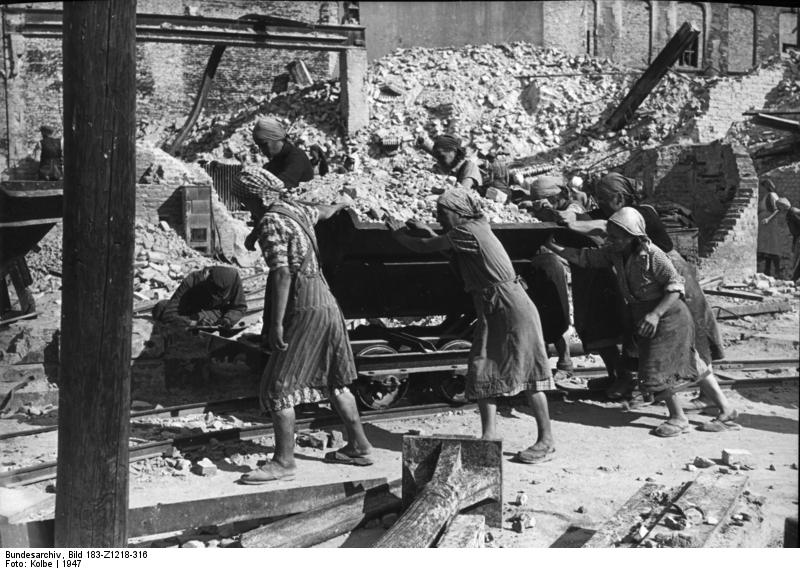
She analyzed government documents related to reconstruction in 11 German cities and concluded the women generally didn’t stack bricks or push rubble on carts. Most of the work was done by removal and construction companies. In the immediate postwar years, she says, there was no term “Trümmerfrau,” and only in Berlin and cities in the Soviet Zone did women do significant amounts of work in the ruins.

When I first heard about this, I thought, “Uh-oh.” Treber is tarnishing one of the beloved images of post-Nazi Germany.

Modern West Germany needed to reinvent its history, create its own founding myths. Every country does it. The “rise from the ashes” story needed its heroes at a time when there were very few to go around. Postwar Germany in the late Forties and into the Fifties was in many areas still clearly in the hands of ex-Nazis. The men wouldn’t be the image of the new Germany. The women who got on with it while the men were imprisoned, broken or dead — they kept society together.

And that’s where myth and memory clash with data. My local paper the NRZ published excerpts of some of the mostly infuriated letters-to-the-editor that arrived after the paper reported on Treber’s book.”The suffering of these women isn’t even appreciated,” one said. Another didn’t hold back: “What is this silly goose thinking when she defames the proven achievements of the Trümmerfrauen?”

Some letters insisted they used the term Trümmerfrau as early as the Fifties here in western Germany. They pointed out that not only did their mothers carry bricks, so did the children (and some men, of course). It wasn’t a matter of rebuilding whole city blocks, it was about the family home, the shop, the school. People rebuilt their own neighborhoods brick by brick. The private stories have poured in, and if you know German, you can read some on the WAZ (NRZ) newspaper group site here.

Treber’s book has gotten some attention for its controversy, and it’s fun to watch. My opinion? A good story is sometimes “truer” than the facts. It isn’t important to measure the achievements of these women in cubic meters of rubble. Postwar German women were the first to pick up the pieces — because they had to. For that, they deserve a place in Germany’s founding story.

Photo:Bundesarchiv, Bild 183-Z1218-316 / Kolbe / CC-BY-SA [CC BY-SA 3.0 de (http://creativecommons.org/licenses/by-sa/3.0/de/deed.en)%5D, via Wikimedia Commons http://upload.wikimedia.org/wikipedia/commons/b/b1/Bundesarchiv_Bild_183-Z1218-316%2C_Tr%C3%BCmmerfrauen_bei_der_Arbeit.jpg

Propaganda films

06 Friday Feb 2015

Posted by Anika in Media, Uncategorized

≈ 4 Comments

Tags

american, british, film, germany, postwar, propaganda

We’d like to think propaganda is the brainwashing a non-democratic country does to its people, or false information it tries to shove on the world. We don’t do that kind of thing.

But propaganda is just media that delivers a political message. Everybody does it. After World War 2, the Americans and British used films to inform the public about the conditions in defeated Germany. They show fascinating period footage. The commentary may be even more interesting.

Check out an episode of “This is America” on Germany 1947. US soldiers teach Germans baseball and English, they play golf to pass the time. “Occupation Girls” live in mansions with German servants. But be warned, the commentator says: The Germans are waiting for a new Führer. They nurse old hates. Two years after the war, the United States urges its people back home to stay vigilant.

And here’s a film from the British Pathé Pictorial Looks at Berlin 1947. There’s a subtle glee in the descriptions of German destruction that probably went down well in post-Blitz England. The commentator can’t resist an ominous warning here too: Will a new war-monger rise from the rubble?

Both films take jabs at the Soviets in Germany. The American film is more obvious about it. The Allies are laying the groundwork in their films for a new, Cold War enemy, while reminding viewers that the old Reich may still be a threat.

Grand Central: postwar shorts

21 Thursday Aug 2014

Posted by Anika in Books, postwar

≈ Comments Off on Grand Central: postwar shorts

Tags

grand central, postwar, short, stories

I’m back from a summer in the USA. It was great. One of the things I did was scour the bookstores at airports and malls for promising new stuff. I found a book that might interest some of you. grandcentral

Grand Central is a short story collection set in 1945. Grand Central Station in NY is the heart or starting point of each tale, as I understand it. I haven’t read it yet, mainly because I’m not so interested in “stories of postwar love and reunion.” Makes it all sound a bit romance-y, which is not my genre.

But it might be yours, and there might be a lot more to these stories if you care to give them a try.

Postwar Artifacts

10 Thursday Jul 2014

Posted by Anika in Everyday life, postwar

≈ Comments Off on Postwar Artifacts

Tags

artifacts, nachkriegszeit, postwar

For those of you interested in seeing postwar artifacts, here’s a quick link from my horde of bookmarks.

Nachkriegszeit.de is all in German, and is mostly lists and links of stuff you can look at like toys or clothes or shoes from the mid-40s and so on. It’s run by a group that offers its collections to museums. I don’t know anything about them, but the website is interesting for anyone who appreciates everyday life objects from the past. If you read German, there’s a lot of good information on the site too.

Liebe, American-style

24 Tuesday Jun 2014

Posted by Anika in Allies, Americans, postwar, Women

≈ Comments Off on Liebe, American-style

Tags

brides, GIs, marriage, postwar

Now that the posts about casual encounters between German women and allied men are out of the way, I thought it was time to do one about the couples that got hitched. The Allied Museum in Berlin has some great information about this in the book to its former exhibition “It Started With a Kiss.” I’ll focus on marriage to American GIs in this post.

It’s pretty well known that GI marriages were a phenomenon. By 1949, about 20,000 German brides and fiancés had moved to the United States. No small feat considering marriages were allowed only since December 1946. Apparently, the first American GIs requested to marry Germans in the fall of 1944 while the war still raged!

People can fall in love under any circumstances, of course, but German women and GIs started out with the kind of baggage no relationship needs. Nonfraternization laws banned romance at first, but when even officers ignored the rules, they were abandoned. The concept of collective guilt cast a shadow over all Germans, even teenage girls who spent most of their lives under Nazi rule. Romance with the victor equaled treason for some Germans.

Some Americans felt the same way. The media reported intensely about the moral dangers of Germany for the boys, and the public debated if and how German women should be allowed into the US. Women called “Nazi-Gretchens” in the US press weren’t necessarily going to be welcomed in American homes.

But there’s no stopping love. The War Brides Act in late 1945 and similar acts in later years laid the foundation for wives and children of US personnel to enter the country.

First they had to meet. Maybe at work, where Germans often took menial or clerical jobs in allied facilities and organizations. Maybe in cafés, restaurants or dance clubs. One German GI bride met her future husband on a Berlin street as she was rushing to catch a bus. She was 19, he was 24. They hit it off right away, but their road to a life together in Brooklyn had more than its share of bumps. Ursula lived in the Soviet sector of Berlin, and couldn’t get the papers to emigrate. She had to finagle an American Sector address via friends. She didn’t talk to many people about her plans out of fear someone would inform on her to the Soviet authorities. Her boyfriend returned to the States in October 1945 and worked from there to cut through the bureaucracy. Only in April 1947 did she board a flight from Tempelhof Airport to New York.

She was one of the lucky ones. She never felt foreign in her new home, since practically everybody was foreign in Brooklyn. Two years after she married, she became a US citizen.

← Older posts
Newer posts →
Follow Postwar Germany on WordPress.com

Categories

  • 1945
  • Allies
    • British
    • French
    • Soviets
  • Americans
  • berlin
  • Books
  • Children
  • Crime
  • Culture
  • Denazification
  • Everyday life
  • general
  • Hunger
  • Jewish life
  • Media
  • Personalities
  • Politics and government
  • postwar
  • Travel
  • Uncategorized
  • Women

Create a free website or blog at WordPress.com.

Privacy & Cookies: This site uses cookies. By continuing to use this website, you agree to their use.
To find out more, including how to control cookies, see here: Cookie Policy
  • Subscribe Subscribed
    • Postwar Germany
    • Join 90 other subscribers
    • Already have a WordPress.com account? Log in now.
    • Postwar Germany
    • Subscribe Subscribed
    • Sign up
    • Log in
    • Report this content
    • View site in Reader
    • Manage subscriptions
    • Collapse this bar
 

Loading Comments...