• About
  • Books
  • Films

Postwar Germany

~ 1945-1949

Postwar Germany

Tag Archives: postwar

Destined to Witness

28 Thursday Feb 2013

Posted by Anika in Personalities

≈ Comments Off on Destined to Witness

Tags

book, Hamburg, journalist, massaquoi, nazi, postwar, witness

Some people live amazing lives.

On a visit to Berlin a few years back, I went to a book reading by a remarkable 80 plus-year-old who I’d never heard of until then. I haven’t forgotten him since.

Hans-Jürgen Massaquoi spoke softly into the microphone in a German tinted with his native Hamburg accent though he left Germany in 1947. HHans Jürgene was a journalist, former managing editor of Ebony Magazine, introducing his autobiography Destined to Witness.

He witnessed Nazi Germany and the postwar years like few others did. His mother Bertha raised him alone in a Hamburg neighborhood. His father, a Liberian student and grandson of the consul general of Liberia in Germany, rarely visited.

So there he was, a half-African German boy under one of the most racist regimes that ever was. He couldn’t hide from the Nazis; his skin would always betray him. Ironically, he didn’t have to hide. He went to school, lived happily with a loving mother, and later learned a trade. The network of people who knew him in his Hamburg neighborhood sheltered him somewhat from the worst of the regime. But the Nazis made it clear he was a second class citizen, and he endured racism from classmates, teachers and others. For him, being second class had a few advantages. He wasn’t persecuted like the Jews, Sinti and Roma. He was forbidden from joining the army, a blessing in disguise.

desinted coverReading his book, I came away with the feeling that his story wasn’t only about growing up mixed race under the Nazis. It was about a boy who desperately wanted to belong, and couldn’t. He wanted to join the Jungvolk, the Hitler Youth for younger children. He wanted to join the Wehrmacht. I didn’t get the impression he was ashamed of having felt this way, and he shouldn’t have been. It’s natural for a child to want to fit in, no matter what environment he grows up in.

He survived the war, the fire bombing of Hamburg, and entered the postwar years. For the first time, he saw men who looked like him, African-American soldiers. After a short stint in Liberia, he emigrated to the United States — a country with its own problems with race. But there, he found what he was looking for. He served in the army, went to college, launched a successful career as a journalist.

At the book reading, he seemed to enjoy every minute of the respect and wonder the German audience gave him. I shook his hand and asked him to sign my copy of his book. A brief encounter, but one I won’t forget.

Hans-Jürgen Massaquoi died on January 19, 2013. RIP.
Postwar children – a health report

12 Tuesday Feb 2013

Posted by Anika in Children

≈ Comments Off on Postwar children – a health report

Tags

children, hunger, illness, postwar

On the playground  in my neighborhood of Essen, an old woman sat beside me on the bench while my daughters and her grandchild played in the sand. We struck up a conversation, and me being me, I asked her if she remembered much from the postwar years.

I remember being hungry. All the time. Once my mother sent me to a shop to get apples for my sister and me. Just two apples. I walked all the way home fighting the urge to eat them. I wanted to lie to my mother and tell her the shop ran out. I loved my sister but I was so hungry, I would’ve eaten her share  even though I knew she’d cry.

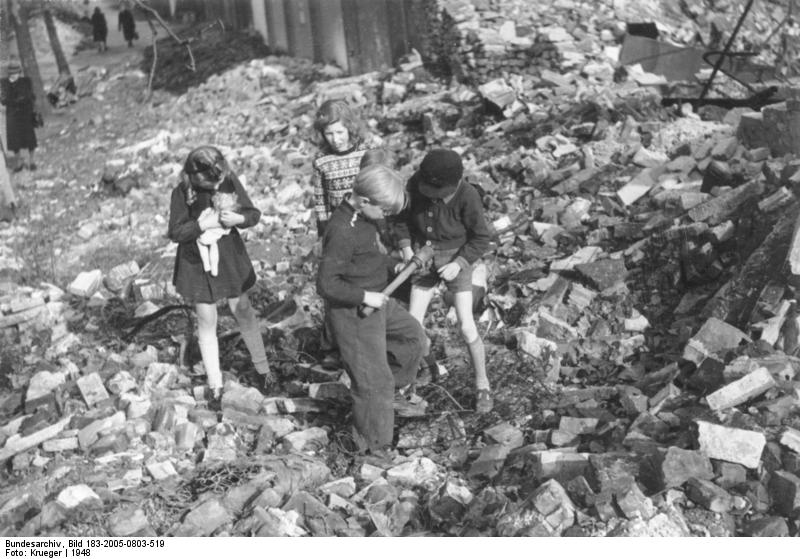
To many people, the only innocents in Germany after the war were the children. Still, they shared the catastrophic living conditions created by the adults. War and postwar children still live with trauma and the memory of shortages, especially of food. Berlin, Kinder spielen in Trümmern

Hunger and bad hygiene took its toll on kids, as I found in a Health Office report of the city of Düsseldorf from 1946. It broke down its report into three sections, and I’ll do that here:

a) Babies: Infant mortality in North Rhine-Westphalia was at 8,5 deaths per 100 births. (As comparison, there were 6,1 deaths per 100 births in 1939). Of the babies who made it into the world, many were underweight and often ill. Milk was hard to come by, and the most ruthless black marketeers sometimes added water to milk to stretch it. In the cold months, infant deaths rose also because households didn’t have any coal for heat. Mothers couldn’t bath their children as often as they needed, and cloth diapers couldn’t be washed and dried adequately.

b) Preschool children: The Health Office reported these children were in worse shape than they were in 1945. Underweight, easily tired, physically weak, anemic. They fell victim to infections and tuberkulosis.

c) School children: They were pale, physically weak, underweight and often had problems in physical development that led to bad posture or gross motor skills. They got sick easily. They had trouble concentrating in school, and on a daily basis, 10 percent of kids didn’t show up to school because they didn’t have proper shoes or clothes. Along with all of the above, teenagers were nervous and apathetic.

Photo: Bundesarchiv, Bild 183-2005-0803-519 / CC-BY-SA via ttp://creativecommons.org/licenses/by-sa/3.0/deed.en Wikimedia Commons

Forgotten years?

06 Thursday Sep 2012

Posted by Anika in general

≈ 1 Comment

Tags

germany, history, postwar

They’re not forgotten by the people who lived them. But when it comes to German history, 1945-1948 are generally known for:

1) Ruins (usually of Berlin)
2) 4-power bickering that lead to a divided Germany and eventually, the Wall
3) Berlin Airlift

Until a few years ago, that’s pretty much all I knew about the time between World War 2 and the Wirtschaftswunder of the 1950s. Somewhere in there, the Deutschmark was born, okay (1948). Germany was bombed to oblivion, you could say, and I had a hard time imagining how it went from that to a successful, modern economy. The Marshall Plan helped, but we know from many parts of the world today that funneling money at people doesn’t mean they’re going to prosper.

I got interested in how people lived in postwar Germany. In the first few years, people from a modern, industrial nation were thrown back to the stone ages. By people, I often mean women and children. Their men were dead, missing, imprisoned, and if the soldiers went home, they weren’t the same men who left. In general, the Germans had to cope with what they saw as the shame of defeat, and the deeper shame of individual (and some say, collective,) guilt. How did they live under those circumstances? What was it like for a child to carry a brick to school every day so that the walls could be rebuilt? What kind of change happens in a mother who silently lets her daughter slip away to be with an Allied soldier in exchange for food? From the Allied side, what were the differences between the Soviet, British and American treatment of Germans in their zones? What was it like for an Allied soldier, often a young man with little life experience besides war, to suddenly be a victor walking around a defeated people?

These are some of the issues I’m interested in. I want to share some of the info and sources I’ve found the past couple of years.

A caveat: I know how delicate some of the topics can be. I’ll try to put “difficult” material in as much context as I can, especially if I quote something from a period source that seems strange or offensive today. I do not in any way support revisionist history that denies Nazi Germany’s atrocities, and I’m not here to make people feel sorry for the Germans of the time. I’m interested in how people lived, what they thought and felt, how they survived. Part of their survival technique was to stay silent. The flood of information about the postwar years came only in the last few decades. I want to show flashes of that unique moment in German history as well as I can.

Newer posts →
Follow Postwar Germany on WordPress.com

Categories

  • 1945
  • Allies
    • British
    • French
    • Soviets
  • Americans
  • berlin
  • Books
  • Children
  • Crime
  • Culture
  • Denazification
  • Everyday life
  • general
  • Hunger
  • Jewish life
  • Media
  • Personalities
  • Politics and government
  • postwar
  • Travel
  • Uncategorized
  • Women

Create a free website or blog at WordPress.com.

Privacy & Cookies: This site uses cookies. By continuing to use this website, you agree to their use.
To find out more, including how to control cookies, see here: Cookie Policy
  • Subscribe Subscribed
    • Postwar Germany
    • Join 90 other subscribers
    • Already have a WordPress.com account? Log in now.
    • Postwar Germany
    • Subscribe Subscribed
    • Sign up
    • Log in
    • Report this content
    • View site in Reader
    • Manage subscriptions
    • Collapse this bar
 

Loading Comments...